Questions?
Call (352) 377-0133
Monday-Friday 9 a.m. - 5 p.m. EST
Hablamos Español
Call (352) 377-0133
Monday-Friday 9 a.m. - 5 p.m. EST
Hablamos Español

Are you a producer thinking about transitioning to organic production? This webpage is for you. Here you’ll find
information about our Transitional program for growers and livestock producers. We’ll also introduce you to the
Transition to Organic Partnership Program (TOPP).

Transitional means that an operator is in the process of meeting the compliance standards under the USDA National Organic Program.
Growers must undergo a three-year transitional period starting from the last known application of any prohibited substance listed in the National List of Allowed and Prohibited Substances. These transitional growers have an Organic System Plan in place, implement practices that are compliant with the National Organic Program regulations, and do not use prohibited substances. For more information about land use requirements, see § 205.202 Land requirements.
Dairy producers can transition an existing, closed herd of dairy animals one time over a 12-month period. These producers must have an Organic System Plan in place and comply with all National Organic Program regulations relating to livestock production during the transition period. For more information about transitional dairy requirements, see § 205.236 Origin of livestock.
2. Submit your Transitional Production Plan to a certifying body, such as QCS, for review.
Poultry operations and handling operations are not eligible for transition.
Poultry must be managed organically starting 24 hours after hatching. This means that an existing poultry cannot be transitioned to organic production. Poultry producers seeking organic certification must procure a new flock and manage them organically starting 24 hours after hatching.
Handling activities (importing, manufacturing, processing) are not eligible for a transition period. Handling operations seeking organic certification must comply with National Organic Program regulations as soon as an Organic System Plan is submitted.
For grower operations, on-site inspections are not required in the first and second year of transition. You can request an optional inspection during the first two years of transition. An on-site inspection is required in the third year of transition, and once per year after certification is achieved, so that an operation can become certified at the end of the three-year transition period.
For dairy operations, an on-site inspection is required during the 12-month transition period and once per year after certification is achieved. Conducting an on-site inspection during the 12-month transition period allows certifiers to finalize their certification decision by the end of the transition period.
No. Only products that have an active organic certification can be marketed, sold, and represented as ‘Organic,’ ‘Certified Organic,’ and/or use the USDA organic seal. Marketing claims such as ‘transitional’ are allowed but may not include ‘organic.’ For more information, see § 205.300 Use of the term, “organic.”
There are two ways to begin the transition process – choose the option that works for you:
1) Complete a Transitional Production Plan from the USDA
a) You can find Transitional Production plan templates developed by the USDA here: Crops | Livestock
i) For growers, a completed Transitional Production Plan, signed by a USDA accredited certification body (certifier), can be used as organic system plan documentation in consideration for USDA transitional crop insurance and may meet part of the application requirements for Conservation Activity Plan 138 under the Natural Resource Conservation Services’ Environmental Quality Incentives Program’s Organic Initiative (CAP 138).
2) Complete required portions of QCS’s Organic System Plan
a) You can find QCS’s Organic System Plan documents here: Organic Grower Plan | Organic Livestock Plan
i)If you would like more information about transitioning to organic production, give us a call at 351-377-0133 or reach out via email. We would love to talk with you!
Once you have completed the documents, submit them to a certifying body, such as QCS, for review.
1) Transition to Organic Partnership Program (TOPP)
a) The Transition to Organic Partnership Program (TOPP) is a network assembled by the USDA’s National Organic Program to support transitioning and organic producers with mentorship and resources.
2) Rodale Institute Consulting
a) Rodale Institute organic consultants are experts and have experience with different crops, soils, and climates throughout the U.S. and are here to work for you wherever you’re located.
3) Organic Transitioning | USDA
a) Information from the USDA’s Agricultural Marketing Service about transitions to organic production practices.
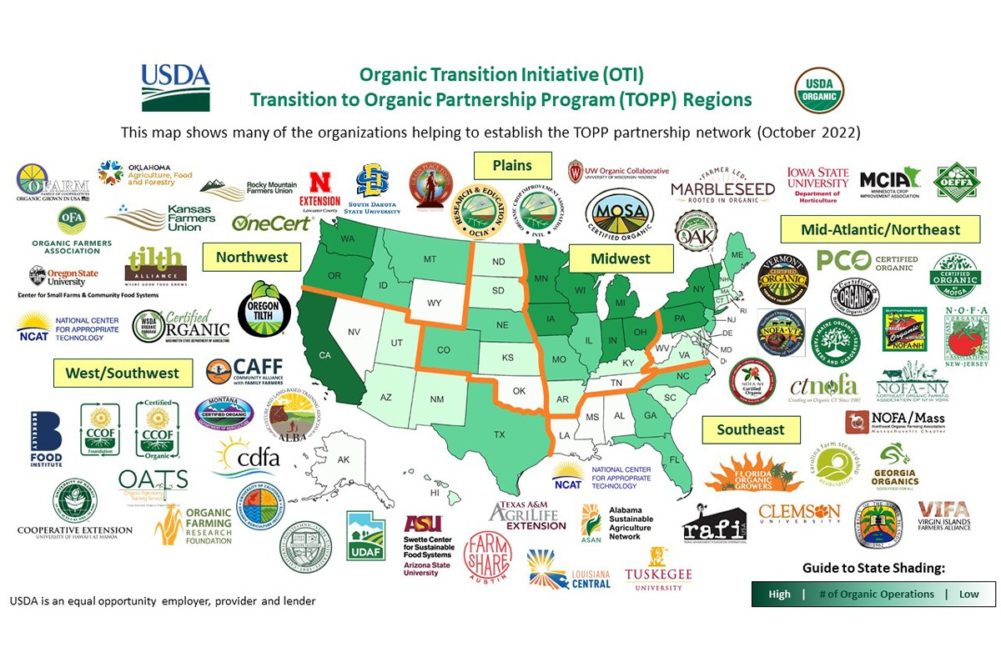
The Transition to Organic Partnership Program (TOPP) is a network assembled by the USDA’s National Organic Program to support transitioning and organic producers with mentorship and resources. The program consists of six regions working together nationwide towards the goal of growing the network of organic producers.
With TOPP, producers transitioning to organic will find support through the transition and certification process. Mentorship, workshops, webinars, field days, technical assistance, and other educational events will offer opportunities to learn about organic production, the certification process, market opportunities, and more.
Find your region on the TOPP website and learn more about mentorship, events, and resources!