Imports & Exports

Welcome to the QCS Imports & Exports Resource Center. These resources are available to help you understand the requirements for importing and exporting certified organic products. Whether you’re a first-time importer or an experienced exporter, you’ll find everything you need to navigate the process with confidence

Imports and Exports

Welcome to the QCS Imports & Exports Resource Center

Importing & Exporting Certified Organic Products

Organic products may be imported into the United States when they are:

  • Certified to the USDA organic regulations, or
  • Certified organic in a country with which the U.S. has an established organic trade partnership.

Learn more about international organic trade arrangements on the USDA website.

New Requirements Effective March 19, 2024

Under the Strengthening Organic Enforcement (SOE) rule:

  • U.S. importers must be certified organic to the USDA National Organic Program (NOP).
  • Each shipment of organic products entering the U.S. must be accompanied by a valid NOP Import Certificate.
  • The NOP Import Certificate must be requested by the exporter from their certifying agent prior to shipment.

For full details, visit the NOP Import Certificate Requirements page.

For clients certified by the US office, please send all requests for transaction certificates and certificates of inspection to imports@qcsinfo.org

Exporting Organic Products to the European Union (EU)

Organic products may be exported to the EU if they:

  • Are produced in the United States and meet the terms of the US-EU Organic Equivalence Arrangement, or
  • Are certified to EU organic standards (or equivalent standards recognized by the EU).

All organic products imported into the EU must be accompanied by an electronic Certificate of Inspection (e-COI). This certificate is issued by QCS through the Trade Control and Expert System (TRACES) prior to shipment.

Learn More About Trade with the EU

Travel Plans for EU-Bound Bulk Consignments

Requests for certificates of inspection for exports of bulk consignments to the European Union (EU) must be accompanied by a Travel Plan . The Travel Plan must identify all premises, their activities, and the means of transport that will occur during the travel of a consignment containing bulk organic products from the last preparation of the organic consignment to its arrival in the EU country in charge of endorsing the Certificate of Inspection.

For clients certified by the US office, please send all requests for transaction certificates and certificates of inspection to imports@qcsinfo.org

Transaction certificates are required for the following types of organic product exports.
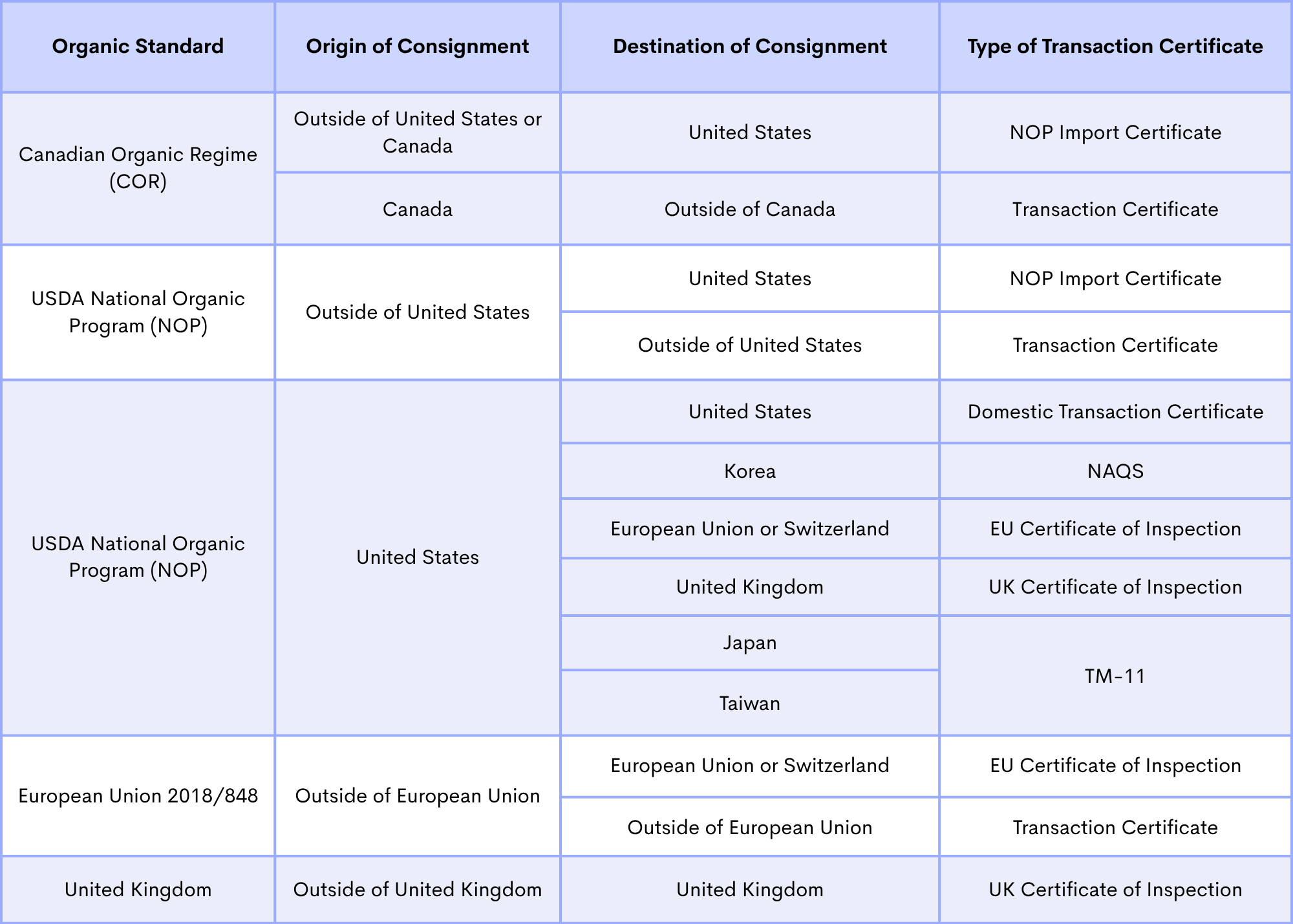
 

table graph


To request a transaction certificate, complete the appropriate form and submit it to QCS with all required documentation as indicated on the form:

Click here for additional guidance about transaction certificates.

For clients certified by the US office, please send all requests for transaction certificates and certificates of inspection to imports@qcsinfo.org

Explanation of NOP Import Certificates

Importing and Exporting

The NOP Import Certificate is a transaction certificate or data set containing detailed information about the quantity and origin of organic product being imported into the United States.  The purpose of the NOP Import Certificate is to document the organic status and quantity of imported organic products as they travel from a certified organic exporter in a foreign country to a certified organic importer in the United States. 

NOP Import Certificates ensure auditable business transactions by documenting that imported products are organic and may be sold, represented, and distributed as organic within the United States. 

NOP Import Certificate Process Overview

After the implementation of the Strengthening Organic Enforcement final rule on March 19, 2024, any organic agricultural product imported to the United States must be associated with a valid NOP Import Certificate, generated by the certifying agent of the final certified exporter sending the product to the United States.  This requirement applies to products certified as USDA organic or traded under an established equivalence arrangement.  Section §205.273 of the USDA organic regulations detail the requirements for imports to the United States.

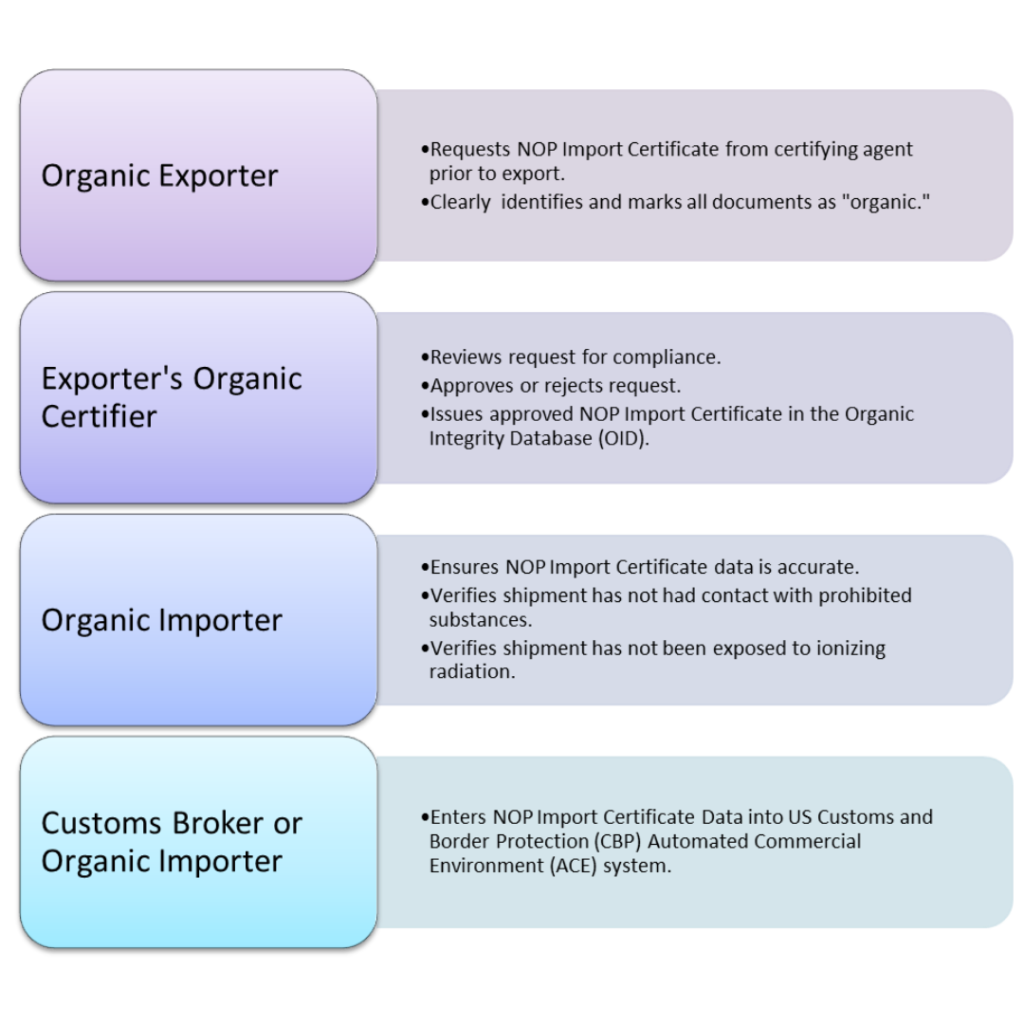
Organic exporters certified by QCS must request a NOP Import Certificate prior to exporting organic products to the US by providing relevant details on the QCS NOP Import Certificate Request Form. You can find the Spanish version of this form here.

NOP Import Certificates may be issued for a specific volume of a single organic product or multiple products with the same Harmonized Tarriff (HTS) Code.  Each product must be certified organic and listed on the operation’s Product Verification Form.  The certified organic exporter must time the request to allow sufficient time for QCS to verify its validity and generate the NOP Import Certificate, and for the exporter to deliver it to the importer or Customs broker before the CBP filing requirements for the product, which may be prior to export.

QCS verifies the validity of the NOP Import Certificate request to ensure the quantify of organic product to be exported is certified organic and organic integrity is maintained.  Approved NOP Organic Certificates are generated within the Organic Integrity Database (OID).  Organic products may not be imported into the United States without an approved NOP Import Certificate.

The certified organic exporter provides the NOP Import Certificate to the U.S. importer.  The importer or their designated customs broker enters the NOP Import Certificate data into the U.S. Customs and Border Protection (CBP) Automated Commercial Environment (ACE) as part of its standard import filing process. 

Organic importers must have a documented organic control system to verify that organic products they receive are associated with a valid NOP Import Certificate and that they not been treated with a prohibited substance as a result of fumigation or treated with ionizing radiation. 

As certified organic products move from the exporting country into the United States, all entry documentation including, but not limited to bills of lading, bills of sale, commercial invoices, and packing lists must clearly state that the product is organic.  Exporting and importing operations must maintain records required under § 205.103.  This includes sufficient records to provide an audit trail to determine the source, type and quantity, transfer of ownership, and transportation of any agricultural product labeled as organic.  

Questions About
Import Certificates?

Importing and Exporting

We know the import process can be complex. If you’re unsure about how to request a NOP Import Certificate, what documentation is needed, or how to ensure compliance, we’re here to help.

🔍 Visit our FAQs page for answers to common questions about NOP Import Certificates and SOE requirements. Check out the Documents Library for all the forms and resources you’ll need.

📧 Still stuck? Email us at imports@qcsinfo.org, or fill out our contact form below, and we’ll send the answer straight to your inbox.

📞 Prefer to talk? Call us at (352) 377-0133.

Imports and Exports
©2025 Quality Certification Services
All Rights Reserved
Privacy Policy